

How the Rohingya Crisis Can Become a Strategic Opportunity to Counter China’s Expansion

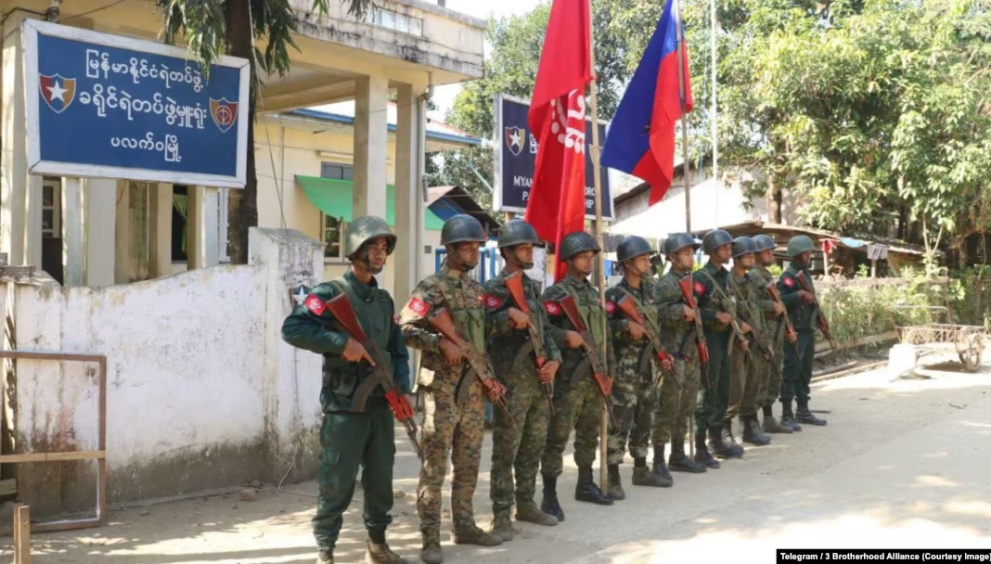
The world says it wants to save the Rohingya, yet at the very moment northern Rakhine becomes more politically fluid than ever, funding is cut, camps inch toward collapse, and Washington seems ready to call it quits.
In recent weeks, the Rohingya crisis has resurfaced in policy discussions for several key reasons. The World Food Programme’s decision in March 2025 to halve food rations for Rohingya refugees in Bangladesh, cutting support from approximately $12.50 to $6 per person per month due to severe funding shortfalls, effectively marked the transition from a “chronic emergency” to an imminent humanitarian collapse affecting over one million Rohingya. Meanwhile, inside Burma, preparations for a general election aimed at legitimizing continued military control are underway, despite highly questionable polling conditions, as much of the country remains in active armed conflict. These developments have prompted renewed attention in Washington, including a recent hearing in the U.S. House of Representatives titled No Exit Strategy: Burma’s Endless Crisis and America’s Limited Options. Against this backdrop, there is renewed urgency to reassess prior regional approaches and identify why previous frameworks failed to create a viable pathway toward stability, protection, or return.
Limitations of Prior U.S.-Partner Approaches
To begin with, India, our key ally in the subcontinent, significantly limited a viable solution for Burma, and given that the previous government under Sheikh Hasina was closely aligned with India, many of these issues were effectively predetermined. Specifically, India’s reluctance to provide refuge to the Rohingya is shaped largely by domestic policies such as the Citizenship Amendment Bill (CAB). The CAB, framed as a humanitarian measure prioritizing certain religious minorities from a defined list of neighboring countries for potential naturalization, does not include Burma or the Rohingya. In practice, this exclusion structurally limits New Delhi’s willingness and political space to engage Rohingya questions directly, which in turn constrained earlier regional options for a more ambitious, India-inclusive response.
Moreover, under Hasina’s leadership, there were limited formal mechanisms to regulate legal entry, manage irregular arrivals, or establish structured frameworks for protection, documentation, and long-term well-being of Rohingya refugees. While education services are available, they are constrained by issues of quality, access, and tight political controls over curriculum. Instruction has often relied on Burmese medium materials, even though most Rohingya primarily speak an unwritten Rohingya dialect, which creates challenges both for student comprehension and for recruiting qualified teachers. At the same time, the political economy of Bangladesh has already driven a steep expansion of Bengali- and English-language education over the past 15 years, suggesting there is room to gradually increase structured access to these languages for Rohingya students, which would offer more accessible instruction and wider regional and international opportunities.
In addition, livelihood and income-generating programs have been limited, despite the urgent need to reduce long-term dependence on humanitarian assistance. Restrictions on digital connectivity, including past limitations on high-speed internet access, further constrained access to education, livelihood training, and communication with the outside world.
With the interim government’s comparatively cooler relations with India, however, there may now be increased flexibility and optimism to explore alternative regional approaches, either without India’s direct involvement or with India engaged through U.S. facilitation.
U.S. Tools to Prevent Humanitarian Collapse in Bangladesh
Humanitarian aid in Cox’s Bazar and Bhasan Char has reached a critical breaking point, as international funding has steadily declined since 2022. This has forced agencies to reduce food rations from approximately 2,100 calories per person per day to nearly 1,200, barely meeting survival thresholds.
The United States and ASEAN now have a timely opportunity to lead a time-bound humanitarian stabilization package for Rohingya refugees in Bangladesh, focused specifically on Cox’s Bazar and Bhasan Char. Washington can draw on existing Migration and Refugee Assistance (MRA) and International Disaster Assistance (IDA) accounts, while working with WFP and UNHCR to restore rations and expand basic services, as ASEAN channels complementary funds through mechanisms such as the ASEAN Coordinating Centre for Humanitarian Assistance and a dedicated multi-donor trust fund. The package should prioritize food security, basic education, English and numeracy skills, and vocational training, with the goal of preparing Rohingya to become more self-reliant and eventually return home once conditions in northern Rakhine permit, rather than promoting permanent resettlement.
This effort should be framed as a burden-sharing compact that mobilizes Japan, the EU, Gulf donors such as Saudi Arabia and Qatar, Türkiye, and key ASEAN states to match U.S. contributions rather than relying on Washington alone. Bangladesh, a key strategic partner, has carried this burden for years to keep the crisis from spilling over into the wider region. However, current circumstances require targeted support to prevent camp collapse, maintain basic WFP food assistance, stabilize border areas, and avert radicalization, trafficking, and maritime outflows. It is also far more cost-effective to stabilize displaced populations where they are than to manage uncontrolled refugee flows into India, Southeast Asia, and eventually Western countries at a later stage.
A Trilateral Framework for Repatriation and Strategic Realignment
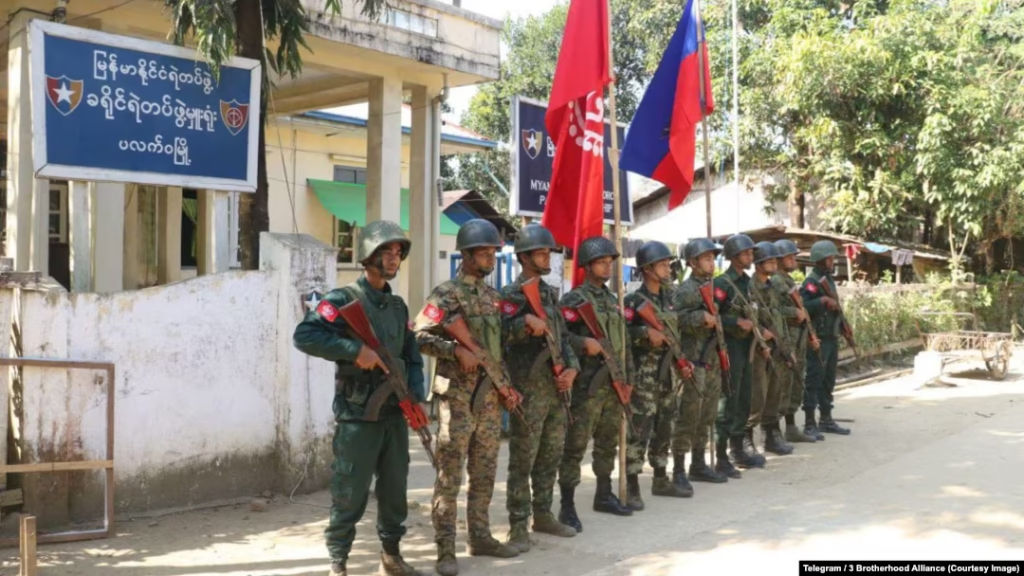
There is an exit ramp for the United States, from a national security perspective, that positions Bangladesh as Washington’s front-line partner in rolling back Chinese influence in the Burmese region while explicitly aligning with India’s security and regional interests. What is different from before is that northern Rakhine is now under the de facto control of the Arakan Army (AA), and Bangladesh’s shared border with them creates an opportunity to pragmatically engage, an opening that would not have emerged under the Hasina administration, given its close ties with India and New Delhi’s concerns about insurgencies and ethno-separatist movements in its Northeast with links to the AA.
The AA is not a military junta backed by China; rather, it is an insurgent rebel group that relies heavily on black-market financing. This means Bangladesh’s military presence on the Rakhine border provides leverage and a relative military edge to U.S. partners in the region. A proposed exit strategy for the United States, Bangladesh, and India would center on creating a Rakhine humanitarian transitional zone that is dependent on Bangladesh and, by extension, the West, not Beijing, for survival and legitimacy.
The AA currently controls much of northern Rakhine but lacks both resources and diplomatic engagement. A trilateral U.S.–Bangladesh–India proposal should include large-scale humanitarian assistance into Rakhine, relieving pressure on Bangladesh, and an international campaign for conditional diplomatic engagement of an autonomous Arakan entity under AA control. This would counter Chinese influence by anchoring a strategically located coastal region to Dhaka and Western assistance. In exchange, (a) the AA would immediately accept the safe return, under U.S.–Bangladeshi–Indian security guarantees, of Rohingya who fled from AA-controlled areas over roughly the past two years, and (b) commit to a phased intake of the remaining Rohingya currently in Bangladesh, tied to benchmarks on security, governance, and rights protections. With Bangladesh–India defense and security leverage over the AA, a mechanism would emerge to make Rakhine presently safe for return.
Diplomatic engagement and humanitarian assistance would be strictly conditional on the new Arakan authority granting interim citizenship documentation, establishing a civil registry, and providing security guarantees to Rohingya residents and returnees. Although this may function as de facto segregation or second-class status in the short term, it is still better than current conditions in Bangladesh and can be mitigated through medium-term status solutions via local administration. The initial phase would be time-bound and geographically focused on northern Rakhine, since return to original villages may be unrealistic at this point. A concentrated, testable pilot zone in northern Rakhine is safer and more logistically viable than an unmanageable, state-wide experiment that disperses Rohingya across the region and exposes them to renewed violence.
By turning northern Rakhine into a humanitarian transitional zone politically and economically anchored to the United States, Bangladesh, and India, the plan inserts a U.S.-aligned buffer directly astride China’s Kyaukphyu port and its oil and gas pipeline corridor to Yunnan, raising the strategic and political cost of unfettered BRI use. At the same time, by structuring this engagement as a trilateral U.S.–Bangladesh–India burden-sharing arrangement focused on stability, repatriation, and limited autonomy for Arakan, it blunts China’s “western outlet to the sea” without undercutting India’s core security interests in its Northeast and also creates common ground between two U.S. partners, Bangladesh and India, whose relations have deteriorated since the summer of 2024.